

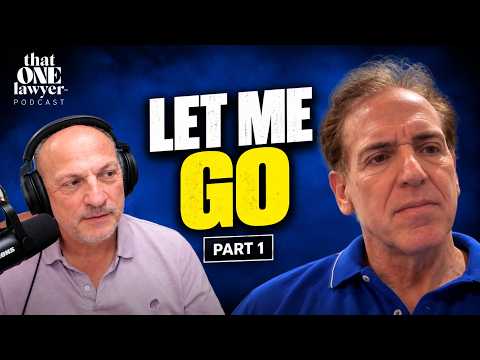
Brian Cuban on the Addiction That Nearly Cost Him His Life
Brian Cuban has been a lawyer, an addict, an author, and a public advocate for recovery and mental health. But before any of those identities, he was a kid trying to understand where he belonged.
This is Part One of my two-part conversation with Brian Cuban.
Brian is widely known as Mark Cuban’s brother. But that relationship is only one part of a much more complicated story. In this conversation, we go back to Brian’s childhood in Pittsburgh and the experiences that shaped the way he saw himself long before addiction entered his life.
Brian talks candidly about growing up with obesity, being bullied and fat-shamed, and internalizing what other people said about him until those judgments became part of his own identity. He remembers the humiliation of what he calls “the day of the gold pants,” when a group of boys physically assaulted him, tore off his pants, and left him to walk home carrying the remnants.
That experience did not simply disappear when childhood ended.
Brian describes arriving at Penn State already carrying intense shame and loneliness. He developed bulimia, began starving himself, ran extraordinary distances, and drank heavily. While thousands of students headed to Penn State football games together, Brian remembers staying behind without friends and running 20 miles so he would not have to confront the isolation he felt.
Then came law school.
Brian did not enter law school because becoming a lawyer was his dream. In fact, he says he wanted to become a police officer. Law school became another way to postpone confronting the outside world while continuing the behaviors he was using to survive.
He entered Pitt Law with an eating disorder and an alcohol problem. He skipped classes to run, showed up drunk or hungover, and graduated “by the skin of my teeth.”
That part of Brian’s story raises a difficult question for the legal profession: How many people enter law school for reasons that have little to do with actually wanting to practice law?
Brian has since spoken with law students who feel pressure from family, expectations, status, or circumstance to pursue careers they never truly chose. For someone already struggling with depression, trauma, substance use, or identity, that pressure can have serious consequences.
Eventually, Brian’s own drinking and drug use became life-threatening.
He describes the 2005 crisis in which his brothers Jeff and Mark intervened after a friend received a disturbing email. Brian recalls being taken to a psychiatric facility while fighting the very people who were trying to save him.
It is also where one of the most important themes of this conversation emerges: connection.
Brian’s father had repeatedly told his three sons that whatever directions their lives took, they needed to pick up the phone and make sure their brothers were okay. Decades later, Brian sees that lesson differently. His brothers were there during some of the darkest periods of his life, even as the family struggled with the difficult boundary between helping someone and enabling an addiction.
This isn’t a story about a famous last name.
It’s a conversation about shame, family, loneliness, addiction, identity, and what can happen when someone spends years trying to escape himself.
In Part Two, Brian and I turn directly to his career as a lawyer, including why he has publicly described himself as an “ambulance chaser,” what he did to get personal injury clients, addiction and drinking inside the legal profession, his transition to writing, and the lesson he still carries from a lawyer and friend he lost.
Subscribe to That One Lawyer Podcast for Part Two and more conversations about the people, relationships, struggles, and choices behind a life in the law.
Brian Cuban – Buy The Book- The Ambulance Chaser: https://a.co/d/04rp5smw
Brian Cuban – Website: https://briancuban.com/
Brian Cuban – LinkedIn: / briancuban
Neal Goldstein – IG- @nealagoldsteinlaw
Neal Goldstein Linkedin – / nealagoldsteinlaw
Neal Goldstein – Books: https://www.amazon.com/Whos-Waiting-R…