

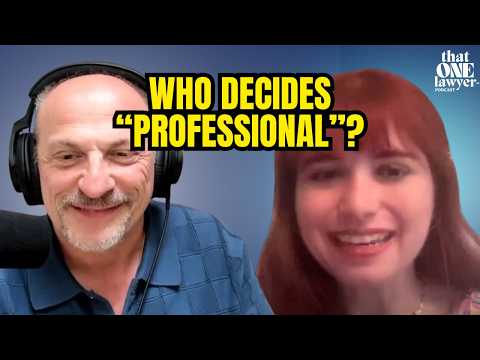
Who Decides ‘Professional’ for Lawyers?
Who actually decides what a “professional” lawyer looks like?
And more importantly, what does it cost you to follow rules that no one clearly defines?
In this episode, Haley Moss breaks down one of the most quietly damaging forces in the legal profession: the pressure to conform to a version of professionalism that shifts depending on who is judging you.
Haley Moss is not speaking from theory.
She became Florida’s first openly autistic attorney, built a legal career, and then stepped away from traditional practice to focus on changing how the profession thinks about inclusion, communication, and workplace culture.
For many lawyers, especially early in their careers, success is not just about doing the work. It is about learning how to present yourself in a way that avoids criticism. What to wear. How to speak. When to push back. When to stay silent.
The problem is that those rules are rarely written down.
They are passed through culture, assumptions, and power dynamics. And they are enforced differently depending on who you are, where you practice, and who is evaluating you.
Haley shares what that looks like in real life.
From being told she wore the wrong thing to court despite following the “rules,” to navigating environments where being direct is seen as unprofessional, she explains how much energy goes into managing perception instead of focusing on legal work.
That tradeoff has consequences.
Not just for individual lawyers, but for the profession as a whole.
Because when professionalism is defined too narrowly, the people who do not naturally fit that mold are pushed out. Not because they lack ability, but because they are spending energy trying to adapt instead of perform.
In this conversation, you will learn:
Why professionalism means something different to every lawyer you ask
How unspoken rules shape law firm culture and career outcomes
What it costs to constantly monitor how you are perceived
Why lawyers struggle to advocate for themselves
How authenticity can strengthen client trust instead of weaken it
What law school does not teach about navigating professional environments
Haley also explains how masking and adapting to expectations led to exhaustion, and how recognizing that pattern changed the direction of her career.
This is not about rejecting standards.
It is about questioning who sets them and whether they are actually serving the profession.
If you have ever felt like you are trying to meet expectations that keep shifting, this conversation will feel familiar.
Subscribe for more conversations that challenge how lawyers think, work, and build their careers.